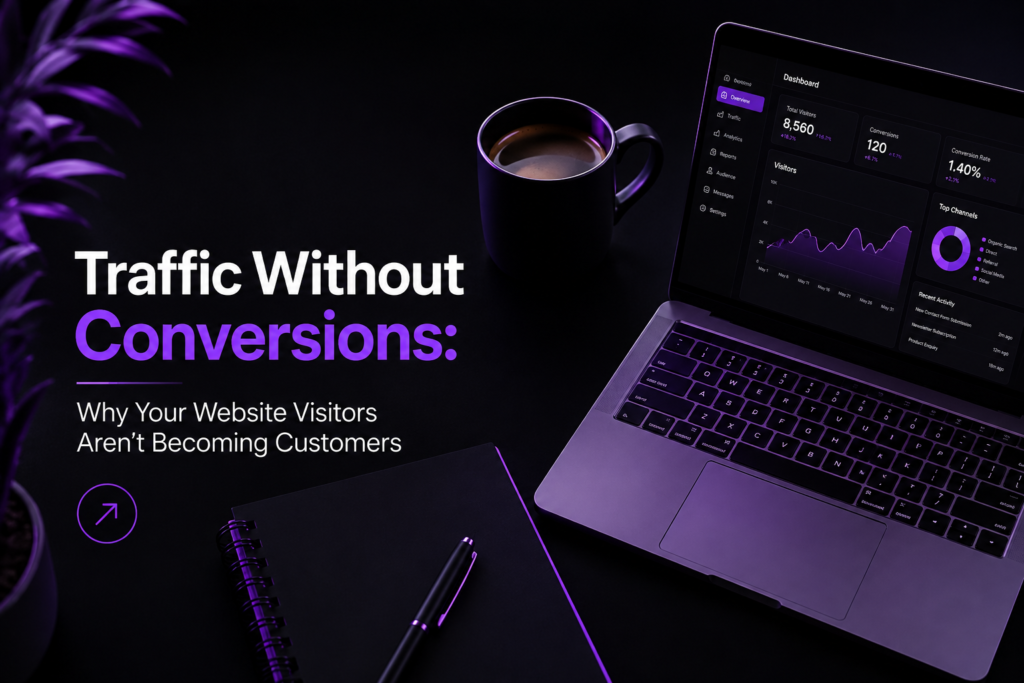
Have you ever checked your website analytics and felt excited to see hundreds—or even thousands—of visitors, only to realize that almost no one filled out your contact form, made a purchase, or subscribed to your newsletter?
You’re not alone.
Many businesses focus heavily on increasing website traffic, believing that more visitors automatically mean more sales. But in reality, traffic is only half of the equation. If your visitors don’t take action, your website isn’t achieving its true purpose.
Why Website Traffic Alone Isn’t Enough
Getting visitors to your website is an important first step, but traffic alone doesn’t guarantee business success. A high number of visitors may look impressive in your analytics, but if those visitors leave without taking action, your website isn’t delivering real results.
Think of your website like a physical store. Imagine hundreds of people walking in every day, browsing your products, and then leaving without making a purchase. While the store is attracting attention, it isn’t generating revenue.
The same principle applies online. A successful website doesn’t just attract visitors—it encourages them to take meaningful actions such as making a purchase, submitting a contact form, booking a consultation, or subscribing to a newsletter.
The real goal isn’t just to increase traffic—it’s to convert visitors into customers.
What Is a Conversion?
A conversion is any valuable action a visitor completes on your website. Depending on your business goals, a conversion can take many forms.
Some common website conversions include:
- Purchasing a product
- Filling out a contact form
- Booking a consultation
- Downloading an eBook or guide
- Signing up for a newsletter
- Requesting a free quote
- Creating an account
Every conversion brings a visitor one step closer to becoming a customer. That’s why digital marketers focus not only on attracting traffic but also on improving the conversion rate.
Why Visitors Leave Without Converting
If your website is getting traffic but not producing results, one or more of these common issues may be preventing visitors from taking action.
Then continue with the six H3 sections:
Your Value Proposition Isn’t Clear
Weak or Missing Call-to-Action (CTA)
Slow Website Speed
Content Doesn’t Match User Intent
Lack of Trust
Poor Mobile Experience
How to Turn Visitors Into Customers
Attracting visitors to your website is only the first step. The real challenge is encouraging them to take meaningful actions that support your business goals. Instead of focusing only on increasing traffic, businesses should optimize their websites to convert visitors into loyal customers.
Create Helpful Content
Provide content that answers your audience’s questions and solves their problems. Instead of constantly promoting your products or services, focus on delivering value. Helpful content builds trust and keeps visitors engaged.
Use Clear Calls-to-Action (CTAs)
Every page on your website should guide visitors toward the next step. Whether it’s “Contact Us,” “Get a Free Quote,” or “Download Our Guide,” your CTA should be clear, visible, and action-oriented.
Improve Website Speed
A slow-loading website can frustrate users and increase bounce rates. Optimize images, reduce unnecessary scripts, and choose reliable hosting to provide a faster browsing experience.
Build Trust
Visitors are more likely to become customers when they trust your business. Display customer testimonials, reviews, certifications, secure payment badges, and clear contact information to build credibility.
Optimize for Mobile Devices
Most people browse websites on their smartphones. Ensure your website is fully responsive, easy to navigate, and performs smoothly on all screen sizes.
Monitor and Improve Performance
Use tools like Google Analytics and Microsoft Clarity to understand how visitors interact with your website. Monitor user behavior, identify drop-off points, and continuously improve your pages based on data.
Frequently Asked Questions
What is a website conversion?
A website conversion occurs when a visitor completes a desired action, such as making a purchase, filling out a contact form, subscribing to a newsletter, or booking a service.
Why am I getting traffic but no sales?
Common reasons include unclear messaging, weak calls-to-action, slow website speed, poor user experience, lack of trust signals, or content that doesn’t match user intent.
What is a good conversion rate?
A good conversion rate varies by industry, business type, and traffic source. Rather than comparing yourself to others, focus on improving your own website’s performance over time.
Does more website traffic always increase sales?
No. High traffic doesn’t automatically lead to higher sales. The quality of your visitors and your website’s ability to convert them are far more important than the number of visits.
How can I improve my website conversions?
Create helpful content, strengthen your calls-to-action, improve website speed, build trust through social proof, optimize for mobile devices, and regularly analyze user behavior to identify opportunities for improvement.
Conclusion
Driving traffic to your website is an important milestone, but it’s only the beginning of the customer journey. The real success lies in turning visitors into leads, subscribers, or loyal customers.
By creating helpful content, improving user experience, building trust, and guiding visitors with clear calls-to-action, you can transform your website into a powerful tool for business growth.